Saturday, June 06, 2009

Why featured pictures is ailing

Reposted from Wikipedia's featured pictures talk page:

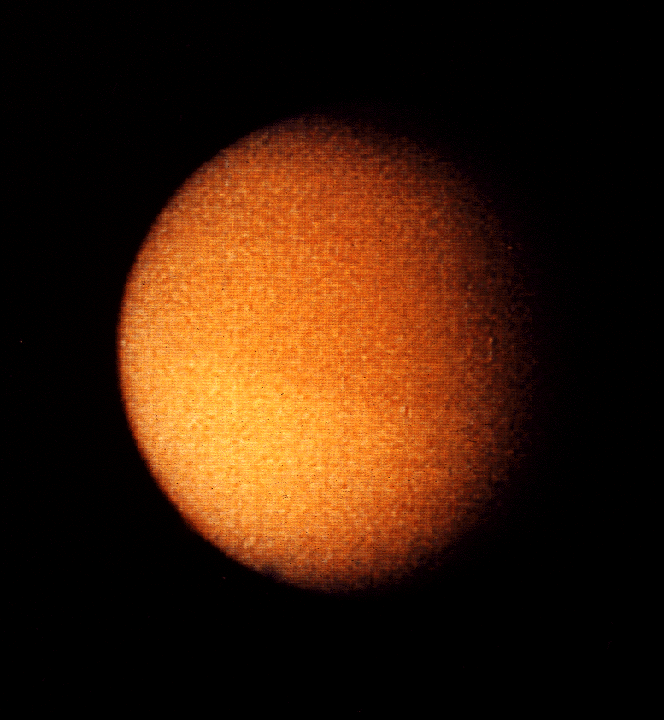
Picking up on the 'crap technical quality' comment in the thread above,[21] a problem in recent months has been myopic understanding of technical quality. One of the best examples to diagnose the ailment is the Titan delisting nomination.

The image is dated 2004, but of course the camera wasn't made in 2004 because the spacecraft was launched in 1997. The exact mass of all the equipment had to be known and tested years before launch in order to plot its course, which included two gravity assist flybys at Venus and Jupiter. So the camera was built with early 1990s technology. It had to perform at temperatures a few degrees above absolute zero in near-total darkness because at Saturn's orbit the sun doesn't provide much more energy than a bright star.

Titan has been visited by spacecraft only three times in human history. The first was Pioneer 11 in 1973, which returned this image. Then the Voyager missions in 1980-1981 shot this. And in order to even do that well with the technology that existed at the time, NASA scheduled Voyager I's final encounter as a close Titan flyby.

The technical challenges that arise after launch add additional layers of difficulty to these missions. Voyager I was nearly destroyed in the rings of Saturn before its Titan encounter because the best technology available when the mission was planned had been unable to detect any matter in the dark zones of its ring system. After the Jupiter encounter the craft sent back images of literally hundreds of rings in the zone of its planned course: a grain of sand would have operated like a bullet on the craft at the speeds it was traveling. Emergency course modifications were extremely difficult to execute, but the mission was saved. Without that rescue, much of the data never would have been obtained that went into planning the Cassini mission.

This is all cutting edge science and sometimes the technical team has to work around hardware failures. One famous save occurred here:

Since Galileo's high-gain antenna failed to open in 1991 the mission was forced to use the low-gain antenna for all communication to Earth. This meant that data storage to Galileo's tape recorder for later compression and playback was absolutely crucial in order to obtain any substantial information from the planned Jupiter and moon flybys. In October 1995, Galileo's 114 megabyte (914,489,344 bits[40]), four-track digital tape recorder which was manufactured by Odetics Corporation, remained stuck in rewind mode for 15 hours before engineers learned what happened and sent commands to shut it off, after recording an image of Jupiter. Though the recorder itself was still in working order the malfunction possibly damaged a length of tape at the end of the reel. This section of tape was subsequently declared "off limits" to any future data recording and was covered with 25 more turns of tape to secure the section and reduce any further stresses, which could tear it.

The software needed extensive rewrites after the antenna failure, then a second round of even more drastic rewrites after the tape recorder failure. And all of the relevant imaging had to be rescheduled and replanned because the data was moving much more slowly, but the craft was still flying at orbital speed.

It simply isn't rational to review the Titan image by the same standards one would apply to a home tripod photo of earth's moon. Of course the Titan mosaic isn't stitched: it was shot for scientific purposes, not for an art gallery. Of course it's contrasty: Titan is the only astronomical body in the solar system other than earth that has liquid at its surface--they were looking for specular reflections.

As stated before, I do have a conflict of interest regarding the Titan image and will disclose fully to anyone who emails a request. So far, no one from the featured pictures program has inquired. Most of the statements in this post are readily verifiable; a few aren't. A barnstar to the first person who detects which information wasn't published officially. Several of the regulars at featured picture candidates need to spend more time reading the articles these images illustrate.

And yet 'crap technical quality' is a comment that gets taken seriously. And the delisting nominator himself hasn't been called to task for saying FPC is not an image gallery and nobody puts quality ahead of EV. Just take a look at the page now and see for yourself. The images that are being opposed because of quality concerns have TERRIBLE quality.(original poster's emphasis)[22] That is an expression of misplaced priorities, superficial understanding, and distorted perspective. Knowledge of digital photography is not a substitute for research. The technical quality of this image is a feat of international science and engineering, and those who deny that reveal their own ignorance. It will likely be a quarter century before better images can be taken of this astronomical object. Those are the realities of science, and this website is an encyclopedia. Cross posting to my blog. DurovaCharge! 21:18, 6 June 2009 (UTC)

Featured picture priorities at Wikipedia

This mosaic of Saturn's moon Titan, taken by the Cassini spacecraft in 2004, "constitutes the most detailed full-disc view of the mysterious moon". It is a featured picture at English Wikipedia, but on 1 June 2009 an editor nominated this image for delisting.

And that delisting nomination, along with the reasoning that led to it, could harm Wikipedia for years to come. It's a shortsighted trend that needs to be stopped.

This was the nominator's rationale:
Noisy, lack of detail, improper focus(?), areas of focus varying.
The first response elaborated:
Delist Woah, that is pretty rough. The stitching is also kind of obvious, especially with the error at the edge of the globe at about the WNW position. The sharp edge is also unrealistic and distracting. Is that a natural background or did NASA just replace with a single black?
In response, another commenter suggested:
If you read the page description, it says that NASA has processed the image to sharpen the surface details.
This has led to a lively debate about featured picture standards. On one side:
Delist - Agree this would make a better VP than FP. Technical quality is low - stitching errors, pixelated edges, inconsistent sharpness, grainy, etc. The EV is extremely high though.
On the other:
Keep This image is not easily reproducable. There is a lack of images of titan, possibly one of the more important bodies in this solar system. And this is currently the best composite image of the whole surface. Please do some reading up on the FPC guidelines. They are there to read, understood and applied, not to be simply ignored.
The issue here is whether esthetics take priority over encyclopedic value in the site's featured pictures. And with that debate rests the fate of the site's relatively new valued pictures program. Encyclopedic value has always been an important consideration at featured pictures and can highly encyclopedic images get priority over esthetics according to the official featured picture criteria, but that's on the verge of changing. From a related nomination to de-feature the nuclear bombing of Nagasaki:
Maybe its time we "demote" some of our lower-quality FPs and fill up VPC with them... We aren't doing harm; maybe this will be a saving grace for the VPC program.
Actually that would a great deal of harm: featured pictures get a turn on Wikipedia's main page. Valued pictures don't. That makes a big difference to the team of volunteers are negotiating with museums and archives internationally to improve access to encyclopedic images. To a museum curator, the chance of a turn on Wikipedia's main page is a golden opportunity: approximately 7 million views per day. That is very persuasive in opening doors and in obtaining large content donations to WMF of many thousands of images.

Put it this way: if you were talking to a Japanese historic archive, wouldn't it be a lot more persuasive to show them the mushroom cloud as a featured picture, and explain that if they released their collection too then their country's perspective--the destruction that actually occurred on the ground--could get equal attention on Wikipedia's main page?

The valued pictures program, which receives no main page attention, is a bureaucratic process that harms Wikipedia by hindering negotiations to gain encyclopedic content. Valued pictures has been nominated for deletion. Both Gerard Meijssen (chairman of the Open Progress Foundation) and Joseph Seddon (a board member of Wikimedia UK) have endorsed the deletion nomination. Meijssen and Seddon are both part of the international volunteer network that is working to open the doors at more image archives.

Friday, June 05, 2009

Stephen Colbert

As you may have heard, he mentioned Wikipedia last night. The video is here.

After five and a half months of arbitration, that was a welcome laugh. Thank you Mr. Colbert.

Thursday, June 04, 2009

Biographies of living persons: An ingenius compromise?

So what do we do about the people who don't want their biographies written up on Wikipedia? The dead trees standard (see last month's post) has some support but not consensus. Well here, for the first time in two years, is a really new solution:

Suppose we noindexed biographies of living persons, upon the subject's request.

First the basics, then the details. Suggestions welcomed.

Basics: A subject who doesn't want his or her biography to show up on Google could email OTRS with a request to have their biography noindexed. The biography itself would remain on Wikipedia, but the search engines wouldn't crawl it anymore.

Details: The ability to noindex in mainspace would be tightly controlled. Policy would restrict its use to BLP articles only, and the developers would toggle the ability only for select users. P possibly this ability would be restricted to functionaries. A log would be generated of all noindexed biographies, which would be reasonably accessible (viewable by all administrators)? The specifics on access would need to be nailed down, but something along the lines of that scope.

Generally speaking, most biography subjects' chief complaint has to do with the high ranking given to Wikipedia articles by search engines--combined with the difficulty in preventing malicious vandalism. Most of the objections to deleting biographies upon request have to do with the desire for encyclopedic completeness. So this looks like a viable compromise. At the very least, it's worth discussing.

Many thanks to the folks at WikiVoices for the brainstorm that led to this idea.

Monday, June 01, 2009

Maturity test: the scoring key

Answer key:
1.
A. 1
B. 0
C. 0
D. 0

2.
A. 1
B. 0
C. 0
D. 0

3.
A. 1
B. 0
C. 0
D. 0

4.
A. 1
B. 0
C. 0
D. 0

5.
A. 1
B. 0
C. 0
D. 0

6.
A. 1
B. 0
C. 0
D. 0

7.
A. 1
B. 0
C. 0
D. 0

8.
A. 1
B. 0
C. 0
D. 0

9.
A. 1
B. 0
C. 0
D. 0

10.
A. 0
B. 1
C. 1
D. 1
Note on question 10: there's a little troll in all of us.

----
Scoring:
0-4: epic fail
5: You're an old admin who got sysopped before 2006. Nobody dares RfC you because you're such a pain.
6: Not banned yet, but on yer way. How's that block log lookin'?
7: Editor.
8: Good editor.
9: Admin.
10: I'd like to talk to you about that proposed decision you're drafting.